Streamlining the Workflow: Conceptualising Architectural Design with AI
- Nov 17, 2024
- 5 min read
In today’s fast-paced design landscape, the integration of AI tools is transforming workflows, but this isn't refined to text generation, with the aid of programs like Midjourney we can streamline the design workflow by creating concepts with the aid of AI image generation. By generating visually compelling images, AI is redefining creative workflows. But what does this mean for the future of the industry? Let’s explore how AI can streamline conceptual image creation, along with the potential benefits and challenges it brings to the table.

Unlocking Potential: The Benefits of AI in Design Concepts
AI image generation is poised to transform the future workflow of designers in the built environment, offering significant advantages that could redefine the creative process. By assisting creativity and encouraging bold, boundary-pushing designs, AI provides a platform for architects and designers to explore ideas that challenge conventional norms. Its ability to generate instant photorealistic visuals streamlines the conceptual design phase, saving time and reducing the workload traditionally associated with early-stage ideation. This not only enhances efficiency but also fosters collaboration, enabling teams to quickly iterate and refine concepts without being constrained by capacity or costs. As a result, AI empowers designers to focus on innovation and creativity, elevating the potential of architectural design.
Igniting a Bold New Era in Architectural Design:
AI image generation has the potential to revolutionise architectural design by introducing fresh perspectives and pushing the boundaries of creativity, particularly during the conceptual stage of a project. For designers facing creative blocks or searching for ground-breaking ideas, AI serves as an invaluable tool to explore possibilities beyond conventional thinking. By generating unconventional forms, surreal concepts, or out-of-the-box combinations of materials and layouts, AI challenges designers to rethink what’s possible. This process not only inspires innovation but also tests our skills in finding practical ways to translate these bold, imaginative visions into reality within the built environment.

The ability to design with purpose, functionality, and unique project requirements remains distinctly human. AI image generation isn’t ready to replace the human touch - at least, not yet. However, AI excels at streamlining the initial conceptualisation phase, generating abstract and inspiring ideas that can spark creativity. By alleviating the pressure of starting from scratch, designers can use AI as a starting block, to build-on with purposeful designs that embody a uniquely human-approach to design.
Instant, Photo-Realistic Variations:
Iterating on a concept is often a time-consuming process, but AI tools simplify this by enabling designers to adjust elements and generate new options almost instantly. This capability encourages experimentation and fosters innovation.


The examples above demonstrate multiple design iterations created using similar prompts, with specific areas of the generated image refined and edited. This straightforward feature allows for quick adjustments in minutes, eliminating the need to redraw 3D models or create entirely new visualizations.
This improves accessibility by providing smaller firms or independent designers with high-quality visualisation tools without the significant time investment that can strain a small team. It empowers designers, who might otherwise hesitate due to the risks of dedicating extensive time to bold concepts, to push boundaries and explore innovative ideas that might have previously felt out of reach.
Streamlining the Workflow:
By incorporating AI image generation into the design workflow, designers can create abstract conceptual visuals in a fraction of the time it once took, significantly reducing time and effort. With simple inputs, such as materials, style or by using reference images, designers can generate high-quality visuals that spark creativity. Instead of spending weeks on ideation, modelling, and rendering, AI produces an image with a single click, saving both time and labour costs. This streamlined process allows designers to focus on refining concepts, experimenting with bold ideas, and exploring innovative solutions.
AI-generated images also enable clients and stakeholders to visualise projects more clearly from the start, fostering more engaged discussions and quicker feedback loops. This leads to more efficient decision-making, as visual concepts can be fine-tuned in real-time. Furthermore, AI's ability to quickly produce multiple iterations of a design provides designers with the flexibility to experiment without the pressure of time constraints. This increased efficiency means that design teams can deliver higher-quality results faster, making the creative process not only more efficient but also more dynamic and adaptable.
The Challenges of an AI-Driven Future
As AI becomes integrated into the workflow of designers, it presents a host of challenges. One concern is the potential loss of creativity and individuality, as over-reliance on AI could lead to laziness in innovation and repetitive use of prompts churning out similar outcomes. Additionally, the human ability to design with social and cultural understanding, function and playfulness may be diminished.
Ethical questions also arise regarding ownership and accreditation. When AI plays a significant role in generating a design, determining who deserves credit for the final outcome may become complex.
These challenges underscore the importance of adopting a balanced approach to integrating AI into design practices, ensuring it enhances rather than diminishes the core of human creativity.
Loss of Human Touch:
While AI is undeniably a powerful tool, its widespread use could lead to a loss of creativity. AI can quickly generate ideas, but it cannot replicate the intuition, emotion, and cultural understanding that human designers bring. By relying too heavily on AI, there’s a risk of loss of style, a quality that distinguishes the renowned architects and designers of today.
An over-reliance on technology is a major concern of bringing AI into the norms of practice. Designers may become dependent on AI-generated visuals, potentially resulting in homogenised designs that lack individuality. Although AI can generate fresh concepts, the repetitive use of similar algorithms and prompts could lead to designs that start to resemble one another, despite appearing innovative in contrast to current architecture. This could limit the diversity of thought and creativity that drives the evolution of design.
Another issue is skill erosion, where foundational abilities like sketching, rendering, and conceptual ideation may decline. These skills are essential for understanding design principles and for communicating ideas in a way that feels personal and bespoke. Over-reliance on AI tools risks creating a generation of designers who may struggle to innovate without the use of AI.
The key to the future of architecture and AI, lies in finding a balance between leveraging AI’s efficiency and preserving the human designer’s creative essence. By using AI as a supportive partner rather than a replacement, designers can streamline workflows while still crafting spaces that resonate deeply on a human-level.
As we navigate this shift, the question isn’t whether AI will change the industry, as it undoubtedly will, but how designers can adapt and harness its potential. The goal should be to shape a design process that is not only innovative and efficient but also deeply human-centred, ensuring that technology partners with creativity rather than diminishing it.
Ethical Concerns:
Questions around originality and authorship arise when AI-generated visuals dominate the creative process.

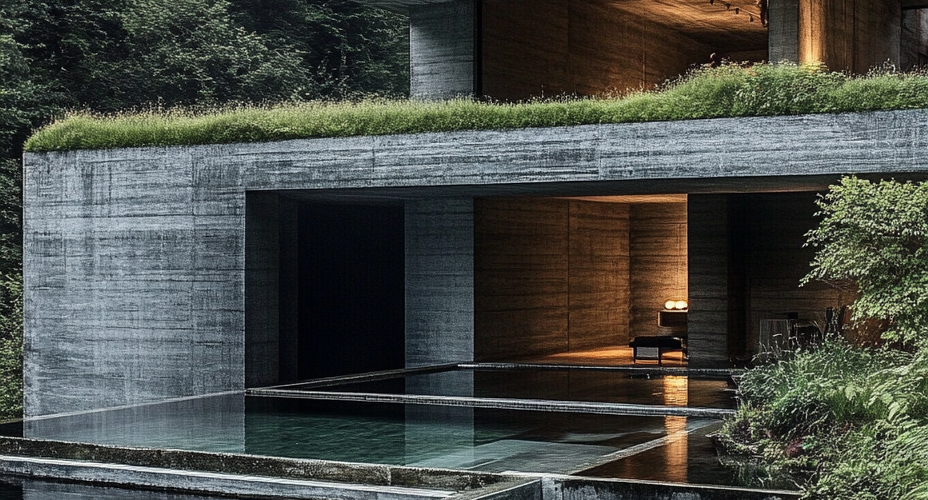


The images above were created using references from the renowned Therme Vals by Peter Zumthor as prompts to generate an architectural exterior. While the AI-generated visuals offer a fresh interpretation, they also bear noticeable similarities to the reference design. This raises important ethical questions: Who should be credited for the resulting design?
While architects and designers commonly draw inspiration from existing works, the ease of generating visuals with AI complicates attribution. Should these new designs be associated with the original architect, even if used solely as a conceptual starting point? The line between inspiration and appropriation becomes increasingly blurred, highlighting the need for clearer guidelines and ethical considerations in the use of AI in design.
What are your thoughts on integrating AI into architectural and interior design?


Comments