Are you Sitting Comfortably? Goodbye Aches; Optimising Your Office Through Ergonomic Analysis
- Sep 16, 2023
- 6 min read
Delving into ergonomics and touching on psychology surrounding workspaces. Observing how we should be sat through research of ergonomic studies, touching on how we can improve aches, pains, and poor posture, and looking to the psychological connection between posture and emotion. Through this brief observation, we hope you will take away new and refreshed knowledge, and put this into practice.

Do you know how to sit? Ergonomics of Office Spaces
How are you, really, sitting? Amy Cuddy explored how posture resents power in your actions and emotions; adopting an open 'power posture' has been found to improve performance, and evoke confidence. Adopting an open posture is important even when no one is looking at you through the camera on a Zoom call,
This power posture will improve your self-confidence, as well as others' impression of you.
Are you still slouched? Sitting straight with open shoulders will reduce your risk of back and neck aches. Try a couple of chair yoga postures, as shown later in this post, to help alleviate aches and open your posture. First, let's take a brief dive into the ergonomics of office spaces.

Let's get into the basics. The chair. An office chair that supports the natural curve of your back is best, if you don't have access to a supportive chair; say you only have space for a dining chair, try lumbar support cushions; these can be used when needed and should give good support to the lower back, and encourage you to sit properly, with your back against the backrest, and not leaning forwards or curving the spine.
Do your feet touch the floor? Your feet should be firmly placed on the ground, if they don't reach, lower your chair or use a footrest. This will also help you to keep the correct leg position, with your knees in line with your hips, or just below.
How about your desk? Whether you are using a hot desk, or kitchen table or have access to a designated office desk, a good desk set-up will help to reduce aches and pains and improve your concentration more than you'd imagine. Your arms (if you're typing on a keyboard) should be parallel to the floor when placed on the desk, with your wrists comfortably facing down to the keyboard. The solution to arms raised too high or too low would be a keyboard tray; attached underneath or in front of the monitor desk, at the correct height. Alternatively, you might want to raise/ lower the chair height.
Moving on to monitors, laptops, and all other screens. Many of you will have two monitors, If you use both equally set them up so they're next to each other, facing towards you, to limit neck and eye strain as much as possible, otherwise, if you use one screen, position this centrally to where you're sitting, with the top of the screen height 2-3 inches above eye-level. The screen should be face-on, not at an angle, as this will likely cause neck and back aches with the constant twisting of the spine. If the monitor/ screen is too low when placed on the desk; try a stand. If you use a raised/ standing desk, make sure that the monitor is on the desk that raises, to maintain the correct display position. Another alternative is a monitor arm, these are also good when you have limited desk space in front of you (for books, etc).
How's the light? Good lighting is essential for reducing eye strain. White lights are most commonly used in the commercial office environment because they produce a bright light and have been shown to stimulate a more energised pace in emotion. If you work before sunrise or after sunset I recommend additional lighting that mimics the changing lux of the sun, you can create a similar effect by using warmer yellow-coloured lights - just turn the warmer lights on when the sun's daylight level is low. Using different levels of lighting is good because it will help to maintain your body's natural circadian rhythm (sleep, wake cycle), this means that you should get better quality sleep, in turn, feel more energised which should aid productivity. You can use this in commercial office settings as well as home office environments. A few simple ways may be; (all of warm yellow/ orange hue bulbs), floor or table lamps, dim-able spotlights, ambient decorative lighting; ensure that the space remains with good lighting and the eyes are not squinted or strained.


Fractal Patterns; Mentally simulative patterns found in nature; incorporate into office spaces through; digital screen wallpapers, artwork, wall coverings/ wallpapers or fabric patterns.
.
The biophilic effect. Encourage natural light where possible, and use daylight-mimicking lighting sources where daylight access is poor. Daylight and views of nature and plants have been found to improve productivity, reduce time taken off sick from work, and improve emotional well-being. Encouraging nature into your workspace is achievable in any space, even with hot desks, You could carry a small artificial plant or opt for natural material finishes (cork, faux stones, or wood) for stationery such as notebooks, these small changes will play an effect in uplifting your well-being and productivity. Where possible implement views and physical elements of nature; artwork depicting natural landscapes or fractal patterns, living or faux planting, natural or artificial lighting mimicking the sun, natural materials or textures. Discover more on biophilic design through past and future posts on the Everyday Biophilia Blog.

Desk partitions, are used to reduce distractions in commercial office environments
Can you hear that? let's talk about distractions. In the open-plan commercial office environment commercial, distractions can be a leading issue for productivity loss. Desk partitions and standing floor dividers are great solutions to reduce the visual distraction of your surroundings; these will also reduce some distractions from sound, a better option for noise pollution are sound absorbing panels; these can be freestanding or positioned on ceilings and walls. For low distractions, planting can be a good choice, leafy medium to tall plants in rectangular planters can be positioned between desks or lining corridors.
Movements for mood
Yoga and movement can help to reduce stress, anxiety, and aches. These 3 movements can be done whilst you're working without leaving your chair, although please do go for short walks where and when you can throughout the day.
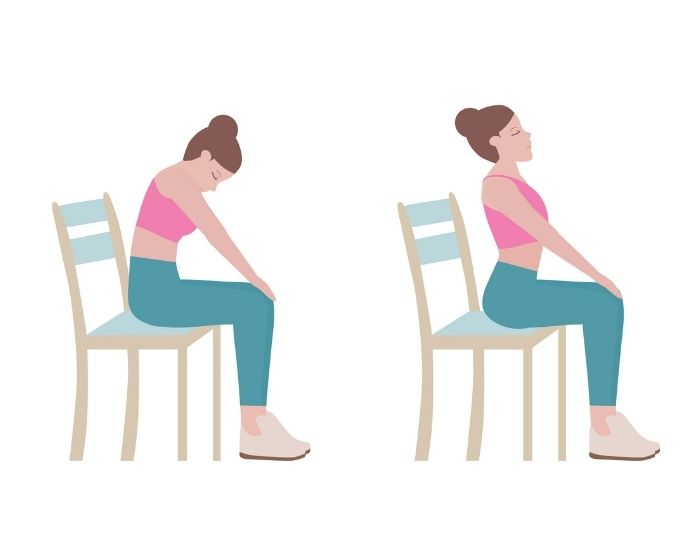
Cat Cow Chair Yoga Stretch // Image From Fitternity
Cat & Cow
How's it done?
Sit up straight with your feet planted on the ground. Facing forwards with your chin up.
Raise your shoulders up to your ears, and roll them back down. Relax. Breathe. Ready?
As you inhale, fill your diaphragm with air, With a slight backbend the chest comes forward
With a slow exhale, release the oxygen from your lungs from the bottom of your stomach to your chest. Gently curve the back and face down, chin comes toward the chest.
How are you feeling? Ready to try this twice more?
What's it good for?
Improves circulation in the back
Eases back and neck aches
Improves posture
Will I be stared at in the office?
A fairly discreet posture. Low stare risk.
Spinal Twists
How's it done?
Sitting up straight, with your feet flat on the floor.
Come to a slowed breath
Inhale as you face forwards
As you exhale twist the right, The left arm can come to the outer right side of the right thigh and the right arm can be placed behind you or where is comfortable
Release and come back to your forward-facing position
Repeat on the left side, twisting to the left with the next exhale. The right arm comes to the outer left side of the left thigh this time, and the left arm is placed behind you are down.
Come back to face forwards, and repeat for 3 on each side.
What's it good for?
Releasing tension in the back
Improves posture
Will I be stared at in the office?
Low risk, a common movement, and easy to 'cool' out. You've got this one!
Forward Fold
How's it done?
Again, we start off with a straight back, facing forward, feet flat on the floor
As you inhale raise your arms straight out to the side and above your head parallel to each other
Slowly exhale and fold forwards at the hips, keeping a straight back. The arms stay stretched out straight in front of you or allow you to drop to the ground. Try not to arch the back too much. Keep your head in line with your spine.
Raise back to an upright seated position and take your next inhale. Repeat this exercise 1-3 times.
What's it good for?
Releasing strains in the back
Enhances the digestive process
Will I be stared at in the office?
Highly liable. But whose back isn't aching now?!
Want to discover more? Here are a few links for further readings & sources on the topics discussed.
Psychology & Posture; https://www.forbes.com/sites/kimelsesser/2020/10/02/the-debate-on-power-posing-continues-heres-where-we-stand/
Podcast from Steven Bartletts' The Diary of A CEO with Amy Cuddy on Body Language;


Comments